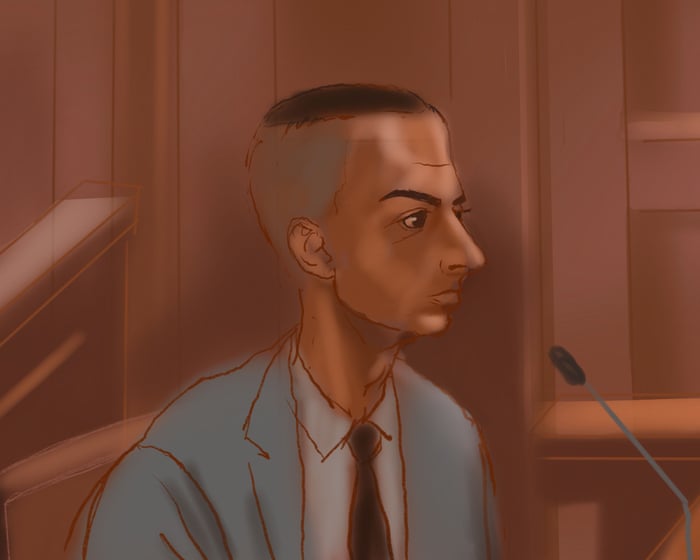
A federal appeals court in New York is weighing whether it can — or should — intervene in President Donald Trump's hush money case, after a state appeals court heard arguments earlier this month in his effort to erase the historic conviction. According to the Associated Press, a three-judge panel of the 2nd US Circuit Court of Appeals spent more than an hour on Monday questioning Trump's lawyer and a state prosecutor about the president's latest bid to shift the case from state court to federal court, where he could seek to have it dismissed on immunity grounds.
Also readIranian singer and four others receive lashes after performance without hijab
There was no immediate decision. The hearing was the second time in 11 days that the two sides have appeared in court, as Trump pursues a two-pronged legal strategy to undo the May 2024 verdict that made him the first former president in American history to be convicted of a crime.
A Manhattan jury found him guilty on all 34 felony counts of falsifying business records to obscure a $130,000 payment to adult film performer Stormy Daniels, made shortly before the 2016 presidential election. Trump has insisted he did nothing wrong and has long described the case as politically motivated.
Also readWhat strike on Russian ship in Libya says about spread of Ukraine war
The two tracks now running in parallel could hardly be more different in what they offer him, and understanding the distinction is essential to understanding why his lawyers are fighting both at once. The state track is a traditional appeal: on November 5, a five-judge panel of the Appellate Division, the mid-level state appeals court in Manhattan, heard arguments that the conviction itself should be thrown out.
Trump's lawyers argued that prosecutors relied on a flawed legal theory by connecting New York business-records charges to federal campaign-finance law, and they challenged the judge's refusal to step aside, the immunity questions surrounding evidence presented at trial, and the instructions given to the jury.
That court has yet to rule, and it gave no indication of when it might. The federal track is a different kind of manoeuvre altogether. Rather than asking a court to find the verdict legally wrong, Trump is asking the 2nd Circuit to take the case away from the state courts entirely and move it into the federal system.
If that transfer succeeds, his lawyers would then ask a federal judge to dismiss the case on presidential immunity grounds, relying on the Supreme Court's 2024 ruling that expanded protections for presidents. The case would first go to a federal district judge, who would adopt the state court verdict, before returning to the 2nd Circuit for arguments and a decision on dismissal.
Trump's lawyer, Robert Giuffra Jr, urged the judges on Monday to act quickly — even before writing their full decision — by issuing an order to take control of the case and stop the Appellate Division's deliberations while the federal question is resolved. The judges did not appear convinced.
Judge John M Walker Jr, appointed to the appeals court by his cousin, former President George HW Bush, and Chief Judge Raymond J Lohier Jr, appointed by former President Barack Obama, both questioned whether the court should intervene at this stage, according to the Associated Press account of the hearing.
Their scepticism matters because it suggests the panel may be reluctant to short-circuit a state appeal that is already under way. Trump turned to the 2nd Circuit after a federal judge in August ruled against him for a third time on the transfer request. Judge Alvin K Hellerstein, who died last month at 92, wrote in that decision that paying hush money to an adult film star or engaging in a cover-up of an embarrassment are not subsumed in presidential immunity.
That blunt sentence has become the central obstacle to the federal strategy: to win in federal court, Trump's lawyers must persuade judges that the conduct at the heart of the case was official presidential business, not a private payment to protect a candidacy.
For now, the conviction stands. In January 2025, shortly before returning to the White House, Trump received an unconditional discharge — no prison time, no fine, no probation — but the guilty verdict itself remains on the record unless a court overturns it. That is what is at stake in both tracks: not his liberty, which was never in question after the discharge, but the historical fact of the conviction itself.
Both sides have signalled that the fight is far from over. Whatever the Appellate Division decides, the losing side is expected to appeal to New York's highest court, the Court of Appeals, and the case could eventually reach the US Supreme Court. The 2nd Circuit, for its part, has no deadline to rule on the transfer question, and it may choose to wait for the state court to act first.
The appeals now moving through the courts will test not only the mechanics of the Manhattan case, but also the reach of presidential immunity and the limits of state-level prosecution involving a sitting president. They also unfold against a crowded backdrop for the White House: the same week, Trump is travelling to Asia, where he is due to meet Xi Jinping and Vladimir Putin at a first trilateral summit in Shenzhen, and his administration is pressing ahead on other fronts, from Yemen's parliament voting to designate the Houthis a terrorist organisation to the fallout from Japan's shrinking economy.
For a president who has made the courts a central arena of his second term, the hush money appeals are a reminder that his legal battles did not end with his return to office — they simply moved into a new phase, with higher stakes and an audience that now includes the Supreme Court.
The fullest account of Monday's hearing was reported by the Associated Press, whose dispatch was carried by news outlets worldwide.