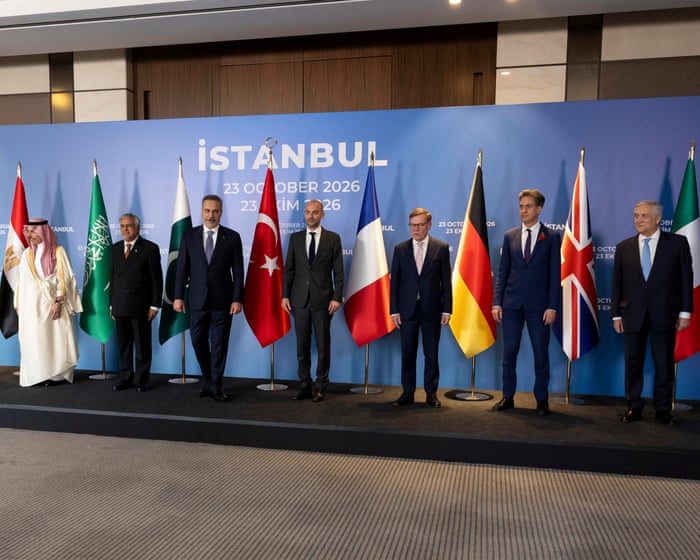
Diplomats gathered in Turkey have issued a direct caution to Washington and Jerusalem, demanding that both governments halt any plans for new military actions against Tehran. According to World news | The Guardian, an emerging coalition of eight European and Middle Eastern nations used a high-level ministerial gathering in Istanbul to advocate for a political resolution to the widening regional conflict.
The multinational assembly positioned itself as an anti-war bloc, pressing for immediate de-escalation as tensions continue to simmer across the Middle East. The report states that the participating foreign ministers emphasized diplomacy as the sole viable path forward, pushing back against military escalation that risks dragging neighboring states into a broader conflagration. Observers note that these diplomatic maneuvers unfold against a backdrop of persistent speculation regarding potential military strategies, as detailed in our previous reporting on U.S. and Israel planning for a possible attack on Iran.
Diplomatic Pushback in Istanbul
The summit brought together senior officials from eight distinct countries across Europe and the Middle East to forge a unified stance against renewed hostilities. By framing their coalition as an anti-war alliance, the ministers sought to present a cohesive counterweight to aggressive military posturing by Western and regional adversaries. The discussions in Istanbul underscored deep anxieties among regional capitals that another wave of airstrikes could shatter fragile stability lines and trigger severe economic and security fallout.
While the coalition insists on dialogue, policymakers in the United States and Israel have historically maintained that military readiness remains an option to deter regional threats. These contrasting positions highlight a widening chasm between Western-allied security objectives and the immediate survival interests of neighboring states positioned along potential conflict corridors. Meanwhile, market analysts and security experts continue to evaluate how upcoming political shifts might alter military timetables, mirroring concerns outlined in our analysis of U.S., Israel may attack Iran post-elections.
Why This Matters
The emergence of this eight-nation bloc signals a notable friction point within traditional alliances, as frontline states refuse to be collateral damage in an escalating geopolitical showdown. For millions of residents living across the Middle East, the prospect of renewed bombardment threatens daily security, vital supply chains, and regional trade routes. European capitals participating in the Istanbul talks are similarly anxious to avert refugee surges and energy shocks that would inevitably follow a wider war.
What to Watch
Observers will monitor whether the Istanbul bloc can translate its anti-war rhetoric into formal mediation channels or if Washington and Jerusalem will proceed with their military planning regardless. Attention will also turn to Tehran's response to these diplomatic overtures and whether any backchannel talks emerge to preempt fresh violence.
Sources: World news | The Guardian